
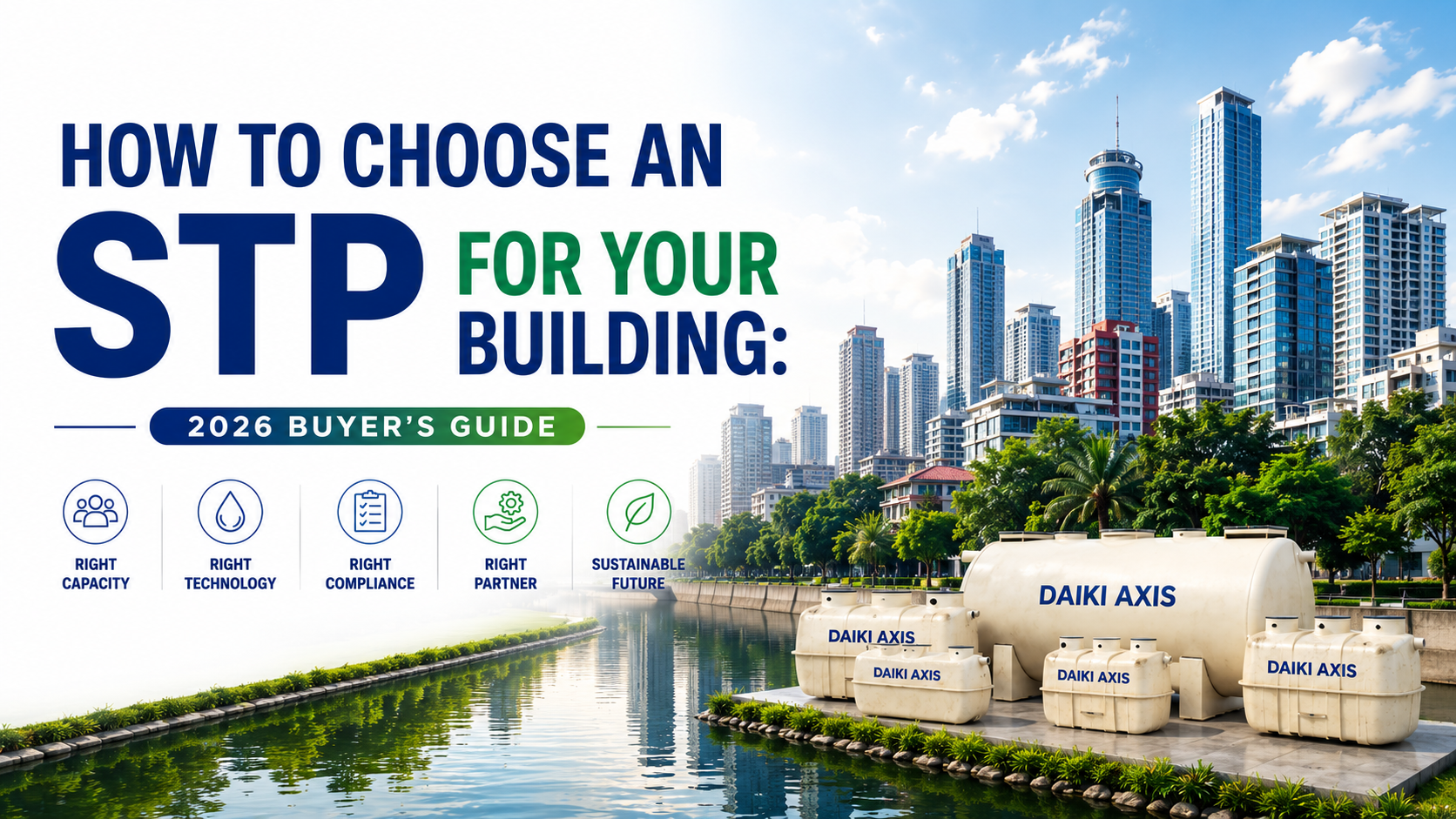
Choosing how to choose an STP for your building is an important decision for any property owner, developer, or facility manager in Bangladesh. A sewage treatment plant is not equipment you can easily replace if it turns out to be the wrong size or technology. Once installed, an STP can serve your building for 15–20 years, so getting the capacity, technology, site requirements, and operating costs right from the beginning is critical.
The right STP for your building depends on several factors, including the number of users, wastewater volume, wastewater characteristics, available space, local regulations, installation conditions, budget, and long-term maintenance requirements.
Here is a practical step-by-step guide to choosing the right sewage treatment plant for your project.
Step 1: Calculate the Right STP Capacity for Your Building
The first and most important step when choosing an STP for your building is determining how much wastewater the plant needs to treat.
STP capacity is generally expressed in cubic metres per day (m³/day). Your required capacity should be based on expected wastewater generation, not simply on your plot size.
For residential buildings, a preliminary estimate can consider:
- Number of apartments
- Expected occupants per apartment
- Average daily water consumption
- Percentage of water that becomes wastewater
- Peak wastewater generation
For example, a 100-flat apartment building with four people per flat will have a very different wastewater load from a 20-flat building.
However, a simple calculation should only be used as an initial estimate. A proper engineering assessment should consider actual water consumption, occupancy patterns, peak flow, and future requirements.
Why STP Capacity Matters
An undersized STP can become overloaded and may struggle to achieve the required treatment performance.
An oversized STP, on the other hand, can result in:
- Higher equipment costs
- Unnecessary energy consumption
- Inefficient operation at low loading
- Higher maintenance expenses
The goal is not to buy the biggest STP. The goal is to select the right-sized STP for your actual wastewater load.
Step 2: Understand What Type of Wastewater Your Building Produces
Before selecting an STP technology, determine exactly what wastewater will enter the system.
Domestic Wastewater
This typically comes from:
- Toilets
- Bathrooms
- Kitchens
- Laundry
- General household activities
A standard domestic sewage treatment system may be appropriate for this type of wastewater.
Commercial Wastewater
Hotels, hospitals, restaurants, offices, shopping centres, and other commercial buildings may produce wastewater with different characteristics.
Additional treatment or pretreatment may be required depending on the wastewater source.
Industrial Wastewater
Industrial wastewater can contain:
- Chemicals
- Oils
- Heavy metals
- High organic loads
- Process-specific contaminants
An STP designed for domestic sewage should not automatically be used for industrial wastewater.
Industrial wastewater may require an Effluent Treatment Plant (ETP) or additional pretreatment.
Always analyze the wastewater before finalizing the treatment technology.
Step 3: Assess Your Building Site Before Choosing an STP
The available site can significantly influence which sewage treatment plant in Bangladesh is practical for your project.
Ask these questions before selecting a system:
- How much installation space is available?
- Is the building new or already occupied?
- Can excavation be carried out?
- What is the soil condition?
- Is the groundwater table high?
- Can heavy equipment access the site?
- Where will treated water be discharged?
- Where will sludge be managed?
New Building vs Existing Building
A new development gives engineers more flexibility because the STP can be incorporated into the original building and site design.
An existing building is different.
You may have limited:
- Basement space
- Parking space
- Open land
- Access for construction equipment
- Space for excavation
This is where compact and modular systems can provide an advantage.
Step 4: Check STP Requirements for Your Location
Choosing an STP is not only an engineering decision. Your system also needs to meet the applicable regulatory and environmental requirements.
Requirements can vary depending on:
- Building location
- Building type
- Discharge destination
- Sewer connection
- Project size
- Applicable RAJUK requirements
- Department of Environment requirements
For example, buildings in Gulshan, Banani, Baridhara, and Niketan are currently subject to specific wastewater-management attention under RAJUK’s evolving enforcement direction.
Your treated wastewater may ultimately be discharged to a:
- Municipal drain
- Sewer
- Canal
- Water body
- Approved reuse system or
- Reuse
The required treatment quality depends partly on where the treated water goes.
Do not select an STP based only on a vendor’s standard capacity chart. Confirm the applicable requirements for your specific project first.
Step 5: Choose the Right STP Technology
There is no single best sewage treatment plant technology for every building.
Your options may include conventional site-built systems, compact modular systems, and other biological treatment technologies.
Traditional RCC STP
A conventional RCC STP is constructed on-site.
It generally requires:
- Excavation
- Reinforced concrete construction
- Waterproofing
- Structural work
- Equipment installation
- Concrete curing
RCC can be a practical solution for large projects where sufficient land is available and the treatment plant can be incorporated into the original design.
Compact Modular STP
Compact modular systems are prefabricated and can reduce the amount of civil construction required.
They can be particularly useful for:
- Apartment buildings
- Commercial buildings
- Existing buildings
- Space-constrained sites
- Decentralized wastewater treatment
Johkasou STP
Johkasou is a prefabricated FRP based wastewater treatment technology designed for decentralized treatment.
Its compact design can make it suitable for projects where:
- Space is limited
- Installation time matters
- Major excavation is difficult
- The building is already occupied
The correct technology should always be selected based on engineering requirements rather than simply choosing the newest or cheapest option.
Step 6: Compare STP Installation Time
Installation time is an important consideration, particularly for commercial developments and existing buildings.
Traditional RCC STP
Site-built RCC systems generally require:
- Excavation
- Structural construction
- Waterproofing
- Concrete curing
- Equipment installation
- Electrical and piping work
- Testing and commissioning
This can take several months depending on project size and site conditions.
Modular STP
A prefabricated system can reduce the amount of construction required at the site because the main treatment unit is manufactured before delivery.
Installation can therefore be significantly faster, although the actual timeline depends on:
- Foundation preparation
- Site access
- Piping
- Electrical work
- Capacity
- Commissioning requirements
Do not compare installation time based only on the equipment delivery date. Consider the complete project timeline from civil preparation to commissioning.
Step 7: Compare the Total Cost of an STP
When comparing STP cost in Bangladesh, don’t look only at the initial quotation.
The real cost of an STP includes:
Initial Cost
- Equipment
- Civil construction
- Installation
- Electrical work
- Piping
- Commissioning
Operating Cost
- Electricity
- Chemicals, where required
- Water
- Operator requirements
- Sludge management
Maintenance Cost
- Preventive maintenance
- Spare parts
- Equipment replacement
- Cleaning
- Inspection
- AMC
A low initial quotation does not necessarily mean a low-cost STP over its lifetime.
A system with better energy efficiency, reliable components, and local technical support may provide better long-term value.
Step 8: Check Energy Consumption Before Buying
An STP operates continuously, so energy consumption becomes an important long-term expense.
Ask the vendor:
- What is the blower power requirement?
- How many pumps are required?
- What is the estimated daily electricity consumption?
- Which equipment operates continuously?
- What happens during low wastewater flow?
Two STPs with the same rated capacity can have very different operating costs.
Always ask for estimated energy consumption before making a purchasing decision.
Step 9: Evaluate the STP Vendor’s Track Record
Choosing the right sewage treatment plant supplier in Bangladesh is just as important as choosing the technology.
Do not select a vendor based only on price.
Ask for:
1. Similar Reference Projects
Can they show projects with:
- Similar capacity?
- Similar building type?
- Similar site constraints?
2. Actual Performance Data
Ask for treated-water test reports from operating installations where possible.
3. Local Technical Support
Find out:
- Who will provide maintenance?
- Are spare parts locally available?
- How quickly can technicians respond?
4. Warranty
Understand exactly:
- What is covered?
- How long is the warranty?
- Which components are excluded?
5. AMC
Ask for a clear Annual Maintenance Contract (AMC) with defined services and pricing.
A good vendor should be able to explain not only what STP they are recommending, but also why that specific system is suitable for your building.
Step 10: Plan STP Maintenance Before Installation
An STP does not become maintenance-free after installation.
Regular operation and maintenance are essential for maintaining treatment performance.
Your maintenance plan may include:
- Routine inspection
- Blower and pump checks
- Sludge management
- Cleaning
- Electrical inspection
- Water-quality testing
- Preventive maintenance
- Equipment replacement when necessary
Ideally, the maintenance arrangement should be finalized before the STP starts operating, rather than waiting for the first breakdown.
STP Buyer’s Checklist for Building Owners
Before purchasing an STP, make sure you can answer these questions:
- ✅ What is my actual wastewater flow?
- ✅ What is my required STP capacity in m³/day?
- ✅ What type of wastewater will enter the plant?
- ✅ What are the peak flow conditions?
- ✅ How much installation space is available?
- ✅ Is the project new construction or a retrofit?
- ✅ What STP technology is suitable for the site?
- ✅ What are the applicable regulatory requirements?
- ✅ Where will treated wastewater be discharged?
- ✅ How much electricity will the plant consume?
- ✅ What are the annual maintenance costs?
- ✅ Are spare parts available locally?
- ✅ Does the vendor have similar reference projects?
- ✅ What does the warranty cover?
- ✅ Is an AMC available?
If a vendor cannot clearly answer these questions, don’t finalize the STP yet. Start your right and best STP project with Daiki Axis Bangladesh.
What Is the Biggest Mistake When Choosing an STP?
The biggest mistake is usually not choosing the wrong brand.
It is choosing an STP without properly understanding the building’s actual requirements.
Common mistakes include:
Choosing Capacity Based Only on Building Size
Plot size does not tell you how much wastewater the building produces.
Choosing the Cheapest Quotation
A low equipment price can hide higher civil, energy, maintenance, or replacement costs.
Ignoring Future Expansion
If your building may expand, plan additional capacity or modular expansion from the beginning.
Ignoring Site Conditions
An STP that looks good on paper may not be practical if there is insufficient space or difficult groundwater conditions.
Choosing Technology Before Assessing Wastewater
The treatment process should match the wastewater characteristics.
Johkasou vs Traditional STP: Which Should You Choose?
For many large, planned developments with sufficient land, a conventional RCC STP can remain a practical solution.
However, compact Johkasou STP systems can be particularly attractive for:
- Existing buildings
- Apartment buildings
- Commercial properties
- Space-constrained sites
- Decentralized wastewater treatment
- Projects where installation time is important
The right answer depends on your site, wastewater flow, building type, and regulatory requirements.
Why a Site Assessment Should Come Before Your STP Quote
A proper site assessment can identify problems before construction begins.
During an assessment, engineers can evaluate:
- Building occupancy
- Wastewater flow
- Existing drainage
- Available installation space
- Soil and groundwater conditions
- Electrical requirements
- Treated-water discharge
- Retrofit limitations
This allows the STP to be designed around your actual building instead of using a generic template.
The cheapest STP is not necessarily the one with the lowest purchase price. The better investment is the system that is correctly sized, properly installed, and practical to operate for years.
Frequently Ask Question
How do I choose an STP for my building?
Start by calculating wastewater generation, understanding the wastewater type, assessing the available site, checking regulatory requirements, comparing suitable technologies, and evaluating the vendor's installation and maintenance support.
How is STP capacity calculated?
STP capacity is generally determined from expected wastewater flow in m³/day. For residential buildings, occupancy and water consumption are important inputs. Commercial and industrial projects may require more detailed flow measurements or water-use audits.
What STP capacity do I need for an apartment building?
It depends on the number of occupants, water consumption, wastewater generation, peak flow, and future occupancy. A professional assessment is recommended instead of selecting capacity from apartment count alone.
Which STP is best for an existing building?
For an existing building with limited space, a compact modular STP can often be easier to install than a large site-built RCC system. However, the final technology should be determined by site and wastewater assessment.
How much does an STP cost in Bangladesh?
STP cost varies significantly depending on capacity, technology, civil construction, equipment, installation, automation, and site conditions. The initial quotation should be compared with long-term operating and maintenance costs.