
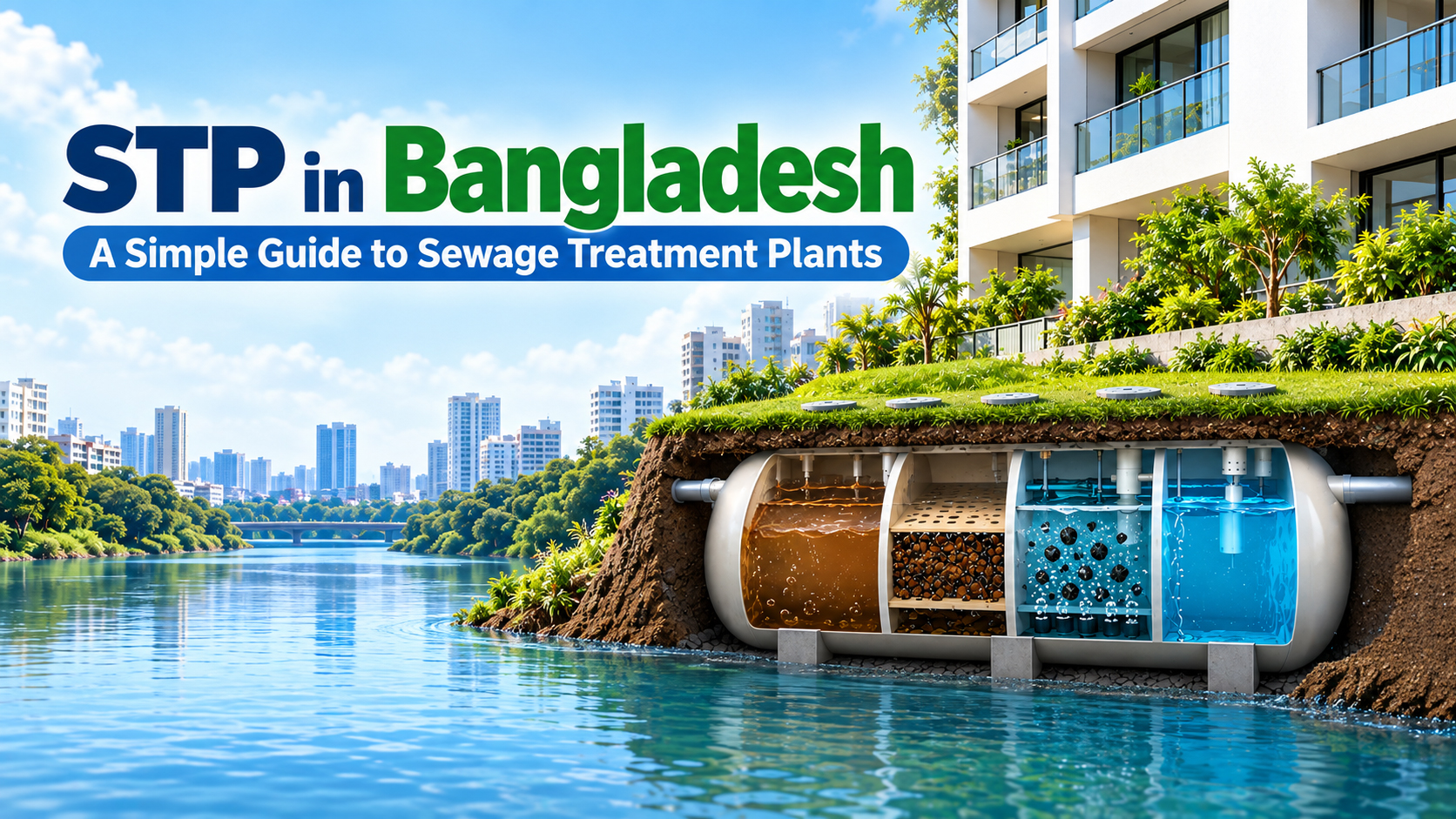
An STP in Bangladesh is a system that cleans the dirty water from toilets, kitchens and bathrooms before it reaches drains, rivers or the ground. Apartment buildings, hospitals, factories and housing projects use STPs to protect public health and to meet Department of Environment (DoE) rules.
Every time someone flushes a toilet in Dhaka, that water has to go somewhere. In much of the city, it does not go to a treatment plant. It goes into a septic tank, a soak well or a storm drain, and from there into rivers like the Buriganga and the Turag.
That is the problem an STP solves. This guide explains what an STP is, why Bangladesh needs more of them, who must install one, and how to pick the right system, in plain words.
What is an STP?
Think of an STP as a small cleaning factory for wastewater. Dirty water goes in on one side. Helpful bacteria eat the waste. Cleaner, safer water comes out on the other side.
Sewage has two parts. Blackwater comes from toilets. Greywater comes from sinks, showers and kitchens. Both carry germs, bad smells and nutrients that harm people and rivers. A good STP removes most of this, so the water can be released safely or reused for gardening, cleaning or toilet flushing.
Why does Bangladesh need more STPs?
Our cities are growing fast, but sewer networks have not kept up.
In July 2023, Dhaka WASA opened the Dasherkandi Sewage Treatment Plant. It was reported as South Asia’s largest single STP, able to treat about 500 million litres a day, or roughly 20 to 25 percent of the sewage Dhaka produces daily (UNB report). That is a big step forward. It also shows how much sewage still goes untreated.
Outside central sewer zones, most buildings rely on septic tanks. A septic tank stores and settles waste. It does not truly clean it. When 40 or 50 families share one high-rise, a basic tank simply cannot handle the load.
Untreated sewage spreads diarrhoea, cholera and other waterborne diseases. The WHO Guidelines on Sanitation and Health make the point that safe sanitation must cover the whole chain, including treatment, not just the toilet.
Is an STP mandatory in Bangladesh?
For many buildings and projects, yes. Under the Bangladesh Environment Conservation Act, 1995 and the Environment Conservation Rules, 2023, establishments and projects that discharge sewage must treat it. Rule 33 of the 2023 Rules covers the construction, approval and operation of sewage treatment plants.
The Department of Environment enforces these rules. In February 2025, it served final notices on 2,046 factories in and around Dhaka. The notices reminded them that sewage must go through an STP and industrial effluent through an ETP (The Financial Express).
RAJUK’s rules for Dhaka are just as clear:
- New buildings on 5 katha or more: an STP is mandatory for any building on a plot of 5 katha (about 3,600 sq ft) or larger.
- Existing buildings in Gulshan, Banani, Baridhara and Niketon: every existing building in these areas must have a functional sewage treatment system.
If your building falls into either group, plan the STP early. It affects design approval, space planning and your timeline.
Places that usually need an STP:
- Any building in Dhaka on a plot of 5 katha or more
- Existing buildings in Gulshan, Banani, Baridhara and Niketon
- Apartment buildings and housing projects
- Hospitals and clinics
- Factories and industrial parks (together with an ETP)
- Hotels, resorts and restaurants
- Schools, universities, offices and shopping malls
- Government buildings and staff housing
How does an STP work? (4 simple steps)
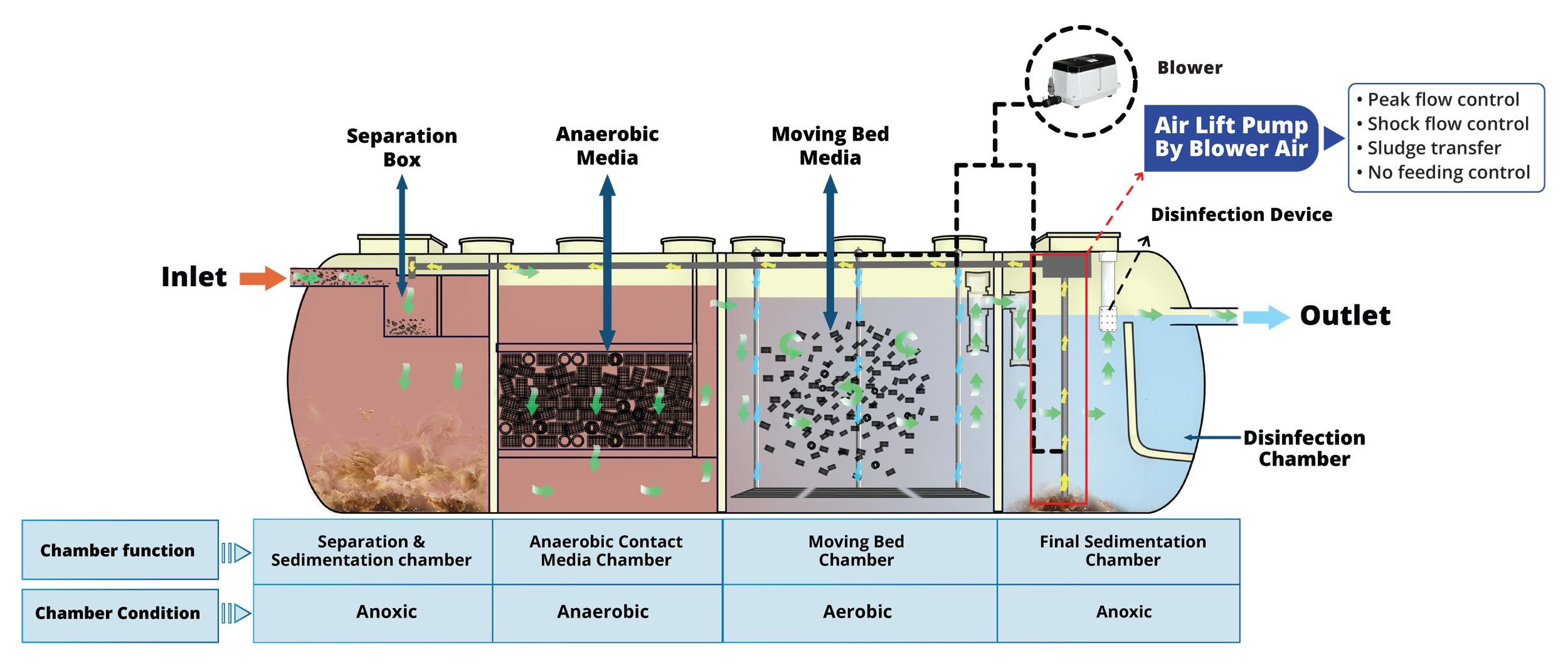
- Collection and screening. Pipes carry sewage to the plant. Screens catch plastic, cloth and other solids.
- Settling. Heavy solids sink to the bottom and form sludge.
- Biological treatment. Bacteria, given air, break down the organic waste. This is the heart of every STP.
- Disinfection and discharge. The water is cleaned further, often with chlorine or UV light, then released or reused. Sludge is removed from time to time.
Types of STP in Bangladesh
There are two main choices for buildings and projects.
| Conventional (civil-built) STP | Packaged Johkasou STP | |
| How it is made | Concrete tanks built on site | Factory-made, compact unit |
| Space needed | More | Less, usually installed underground |
| Build time | Longer, depends on civil work | Shorter, the tank arrives ready |
| Best for | Very large, centralised flows | Buildings, hospitals, housing, decentralised sites |
Johkasou is a Japanese technology for treating wastewater close to where it is produced. In Japan, it is covered by its own law, the Johkasou Act, which sets rules for installation, operation and inspection (Japan Ministry of the Environment). For Dhaka, where land is expensive, a small underground footprint is a real advantage. For more detail, read our Johkasou vs traditional STP comparison.
How to choose the right STP
Ask these six questions before you buy:
- How much sewage do we produce? Capacity is measured in cubic metres per day (m³/day). It depends on the number of people and daily water use.
- How much space do we have? Basement, ground or underground options change the design.
- Will treated water meet DoE standards? Ask for the expected output quality in writing.
- Who will run and maintain it? Ask about desludging, electricity use and service visits.
- Have they done projects like ours? Ask for completed sites you can visit.
- Is after-sales support local? Spare parts and engineers in Bangladesh save time when something goes wrong.
STP in Bangladesh: how Daiki Axis can help
Daiki Axis Bangladesh is the Dhaka-based subsidiary of Japan’s Daiki Axis Co., Ltd. We supply Johkasou-based STPs and have completed more than 100 projects. These include a 450 m³/day system at Aligonj Government Housing and a 250 m³/day system at Tangail Medical College Hospital for the Public Works Department. We support you from site survey and design to installation and maintenance.
What does STP stand for?
STP stands for Sewage Treatment Plant. It is a system that cleans wastewater from toilets, kitchens and bathrooms before the water is released or reused.
What is the difference between an STP and an ETP?
An STP treats domestic sewage from people. An ETP (Effluent Treatment Plant) treats industrial wastewater that may contain chemicals and dyes. Many factories in Bangladesh need both. See our full ETP vs STP comparison.
Is an STP mandatory in Bangladesh?
For many factories, projects and large buildings, yes. The Environment Conservation Rules, 2023 cover sewage treatment plants, and the Department of Environment enforces them. Check your project's DoE and RAJUK requirements.
Is a septic tank enough for an apartment building?
Usually not for large buildings. A septic tank stores and settles waste but does not fully treat it. Multi-family buildings produce more sewage than a basic tank can handle safely.
How much does an STP cost in Bangladesh?
There is no single price. Cost depends on capacity, technology, site conditions and maintenance needs. A site survey is the best way to get an accurate quote. Our guide to STP cost in Bangladesh explains the main cost factors.
Talk to us
Planning a building, hospital or factory? Get a free site survey from Daiki Axis Bangladesh. House 15A, Road 35, Gulshan-2, Dhaka 1212
·+8801958063200 | info@daiki-axisbd.com