
As of today, May 2, 2026, the streets of Dhaka are once again wading through the aftermath of heavy pre-monsoon downpours. From the knee-deep water at the Green Road–Panthapath signal to the submerged lanes of Mirpur-10, the irony of our capital is clear: we are a city drowning in runoff while our underground reservoirs are running dry.
Just last year, during World Water Week 2025, the “Empty Pitcher Procession” in Chattogram gave a haunting visual to this crisis. Hundreds of women marched with dry clay pots, demanding safe water and the protection of our groundwater. This wasn’t just a protest; it was a wake-up call for every real estate developer and homeowner in Bangladesh. We can no longer treat water as a “use-once-and-discard” commodity.
The era of the Circular Water Economy has arrived.
The Alarming Reality: Dhaka’s “2-Meter Drop”
For decades, Dhaka has survived on a stolen future. We extract over 3,500 million liters of water daily, with nearly 80% of that coming from deep tube wells. This over-reliance has caused the groundwater table to plummet by 2 to 3 meters every single year.
In 1970, you could find water just 6 meters below the surface. Today, in central hubs like Motijheel and Gulshan, you have to dig deeper than 73 meters. If we don’t change our architectural philosophy, experts predict the table will hit 110 meters by 2050—a depth that makes extraction both economically and ecologically ruinous.
A New Era of Hydro-Diplomacy: The UN Water Convention
In June 2025, Bangladesh made history by becoming the first South Asian country to join the UN Water Convention. This legally binding framework isn’t just about sharing the Ganges or Brahmaputra with our neighbors; it is a commitment to domestic water stewardship.
By joining this convention, Bangladesh has signaled to the world that we are moving toward a decentralized model of water governance. For the building industry, this means that individual residential and commercial complexes are now expected to act as mini-utilities—treating, recycling, and recharging every drop they consume.
Transitioning to a Circular Water Economy in Bangladesh
The traditional linear model of “Take-Make-Waste” is failing. In a circular economy, the focus shifts to “Take-Remake-Restore.” For a residential building in Uttara or Banani, this means transforming “sewage” into a “resource”.
1. Greywater Recycling Systems: The Low-Hanging Fruit
Did you know that up to 60% of a household’s water usage doesn’t need to be drinkable? Water from sinks, showers, and laundry—known as greywater—is relatively clean and easy to treat.
By installing a dedicated greywater recycling system, a building can capture this flow, treat it onsite, and reuse it for:
- Toilet Flushing: Reducing total freshwater demand by 30-40%.
- Urban Gardening: Bangladesh’s new “Green Roof” initiatives require consistent irrigation, which treated greywater can provide for free.
- Car Washing & Construction: Essential for the maintenance of high-end apartment complexes.
2. Decentralized Treatment: The Johkasou Advantage
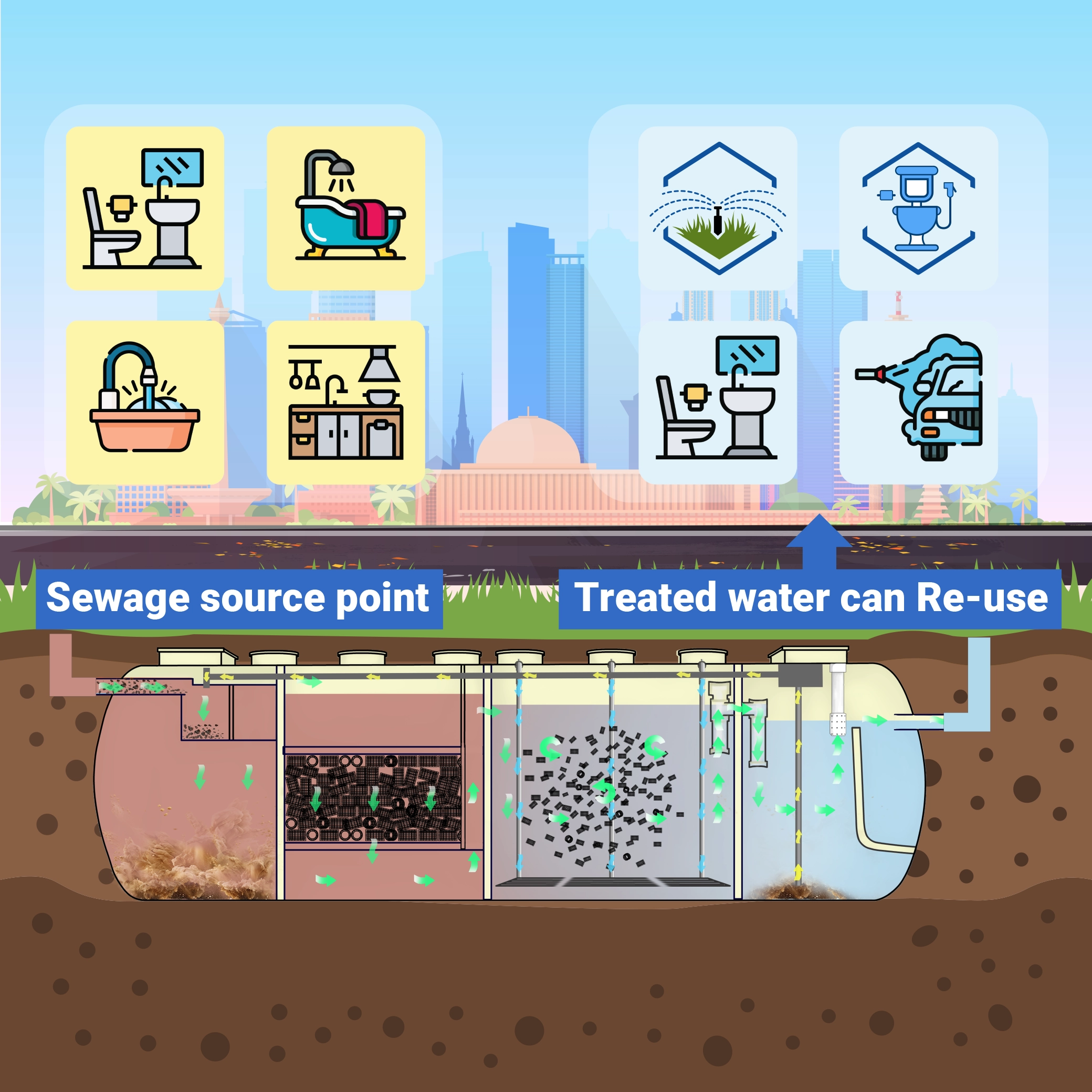
While greywater is easy, managing “blackwater” (sewage) has traditionally been the challenge. This is where Japanese Johkasou technology from Daiki Axis Bangladesh is revolutionizing the circular model.
Johkasou is a prefabricated, decentralized system that treats all domestic wastewater in a single, compact FRP tank. Unlike the old, smelly septic tanks that merely store waste, Johkasou uses high-efficiency biological processes to purify water to ECR 2023 standards (BOD 30–40 mg/L) right under your parking lot.
Green Building Certifications: Boosting Property Value
In 2026, “luxury” is no longer defined by marble floors; it is defined by sustainability. Real estate developers are now racing to achieve LEED (Leadership in Energy and Environmental Design) v4.1 certifications to attract high-value tenants and international buyers.
How water reuse earns you points:
- Water Efficiency (WE) Credits: Under LEED v4.1, buildings can earn significant points by using a minimum of 20% to 40% recycled alternative water for process needs.
- Permanent Metering: Installing smart IoT meters to track usage—a key feature of modern Johkasou systems—is a prerequisite for certification.
- Operational Savings: LEED-certified buildings in Dhaka are reporting up to 11% reductions in overall water consumption, translating to millions of Taka saved in WASA bills over the building’s lifecycle.
The Human Element: Gender and Water Justice
The water crisis in Bangladesh is not just an engineering problem; it’s a social one. On World Water Day 2026, the theme “Water and Gender” highlighted a painful truth: women and girls in our coastal and peri-urban areas spend up to 6 hours a day just fetching water.
When we implement water reuse in urban buildings, we reduce the total pressure on the national grid. This, in turn, allows authorities to redirect more resources to underserved communities. By adopting a circular water model in your apartment complex, you are indirectly contributing to gender equality and education for girls across the delta.
FAQ
1. What is the update on Dhaka’s groundwater depletion in 2026? Dhaka’s groundwater continues to deplete at a rate of 2–3 meters annually. In central areas, the water table has now reached a depth of over 73 meters, making surface water treatment and rainwater harvesting an urgent necessity.
2. How does Bangladesh’s accession to the UN Water Convention affect property owners? The convention encourages better domestic water governance and a shift toward decentralization. This aligns with RAJUK’s current mandate requiring onsite STPs for buildings on 5-katha plots or larger, forcing owners to manage their own waste sustainably.
3. What are the benefits of greywater recycling for residential buildings? Recycling greywater from baths and sinks can reduce a building’s freshwater demand by nearly 50%. The treated water is safe for non-potable uses like toilet flushing, floor cleaning, and landscaping.
4. How do I get points for water recycling in LEED v4.1? You can earn up to 3 points by demonstrating that your project uses at least 20% recycled alternative water for process water demand, such as in cooling towers or boilers.