
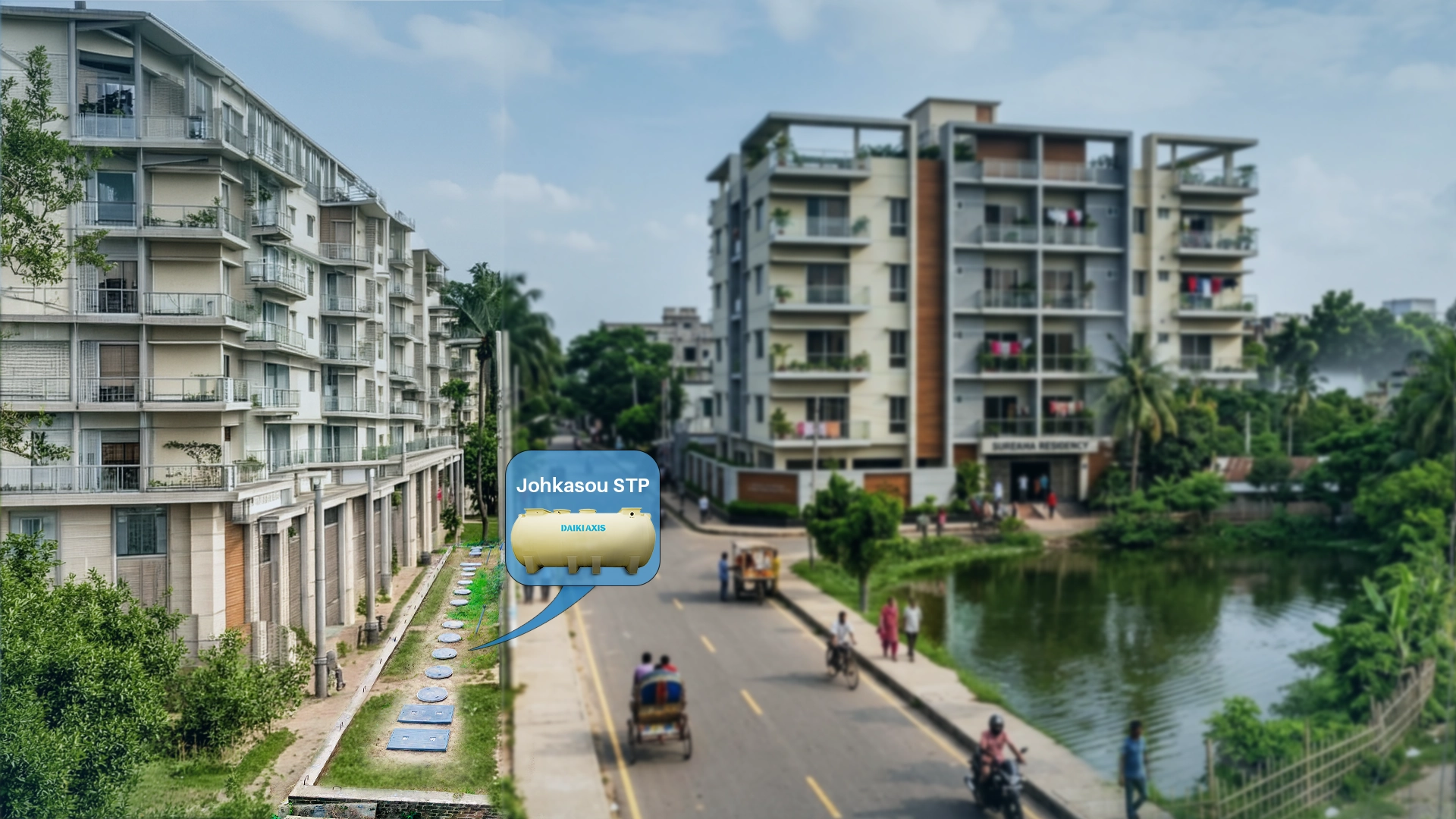
If you are planning an apartment building, villa project, or private residence in Bangladesh, wastewater is not a small utility decision. It affects approvals, resident comfort, land use, maintenance cost, and the long-term reputation of the property. In a market where sewer coverage is still limited and environmental scrutiny is increasing, a compact on-site treatment system is no longer optional for many projects. It is practical risk management.
Johkasou: The Reliable and Compact Sewage Solution in Bangladesh
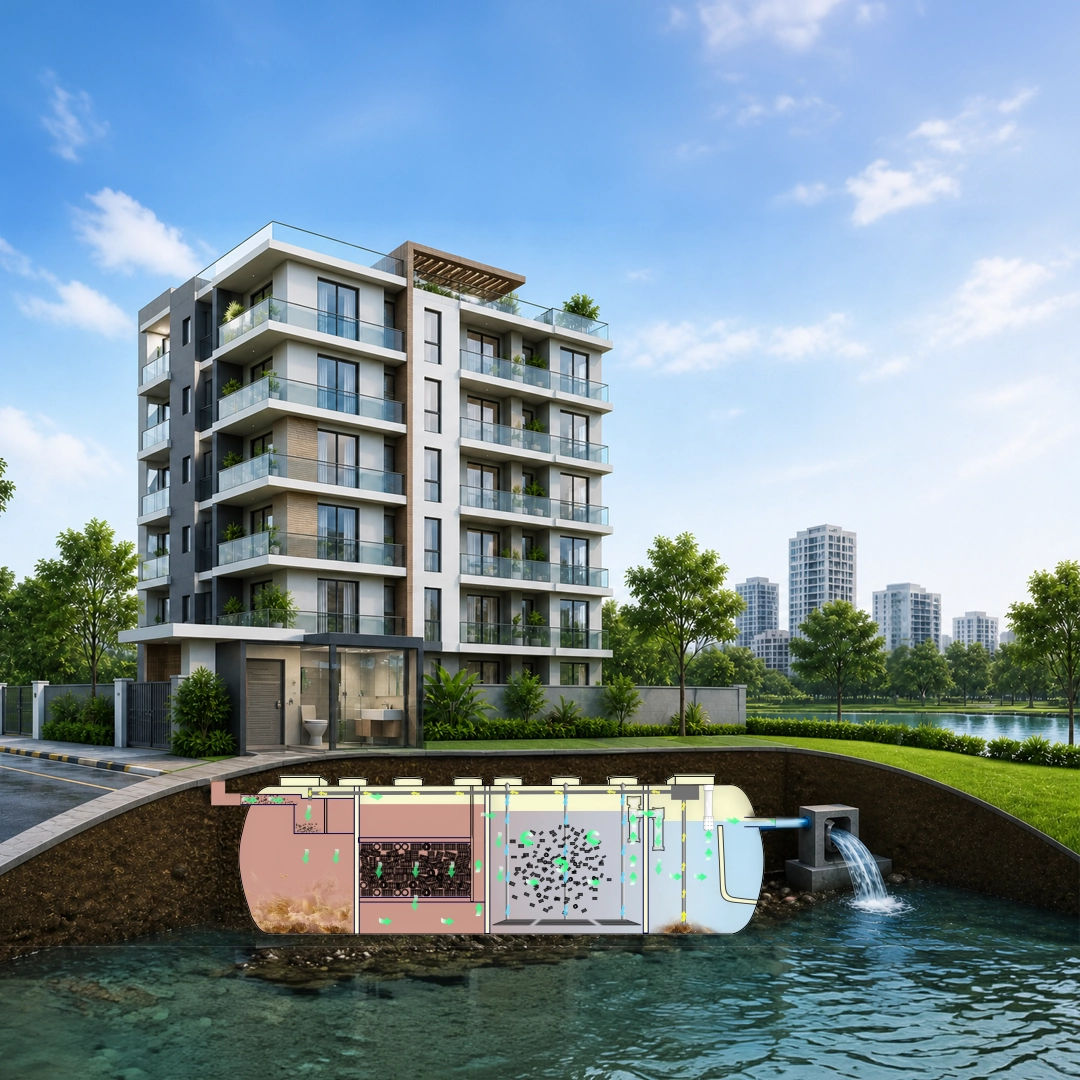
If your search started with compact STP for apartments in Bangladesh or residential sewage treatment plant Bangladesh, Johkasou is built for exactly that problem. Johkasou is a prefabricated, decentralized wastewater treatment system developed in Japan to treat sewage where it is generated instead of depending on a large centralized sewer network. Daiki Axis Bangladesh positions it as a compact, efficient system for apartments, villas, gated communities, and mixed-use developments, with reuse potential for irrigation, landscaping, and toilet flushing where project design allows.
Learn more about Johkasou
Book a site assessment for your apartment or housing project
For builders, the first advantage is space efficiency. Official Japanese Johkasou material says household-scale units can fit in roughly the space of one parking spot and that installation can take about one week. In dense cities, that matters. It gives you a more realistic way to preserve usable site area while still planning for proper wastewater treatment. Instead of treating sewage as an oversized civil afterthought, Johkasou lets you integrate treatment earlier into the building plan.
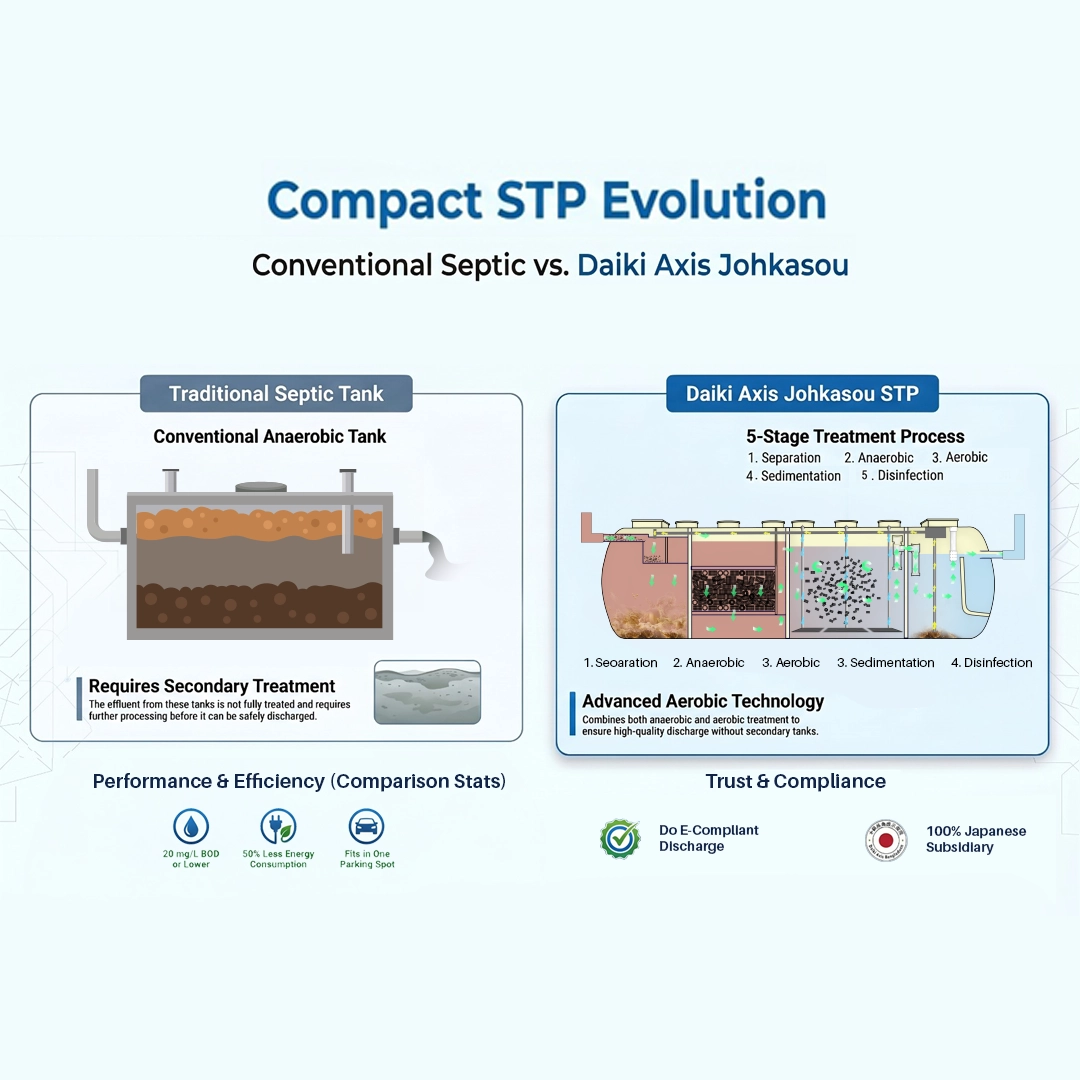
The second advantage is treatment quality. Official Japanese technical material says Johkasou can achieve treated water quality around 20 mg/L BOD or lower with BOD removal of 90% or more, and advanced nitrogen and phosphorus treatment is also possible. Daiki Axis explains this through a multi-stage process that combines separation, anaerobic treatment, aerobic treatment, sedimentation, and disinfection. Compared with a basic septic approach that is anaerobic-only and still needs retreatment of effluent, Johkasou gives buyers a cleaner, more engineered outcome.
The third advantage is operational practicality. Daiki Axis states that Johkasou uses about 50% less energy than conventional sewage treatment plants and does not require a resident operator to constantly monitor it. Daiki Axis Bangladesh also emphasizes long-term support, testing, commissioning, and operation-and-maintenance positioning around every installation. For a builder, that means a packaged system with more predictable handover and fewer operational surprises than many fully site-built alternatives.
STP is now Mandatory in Bangladesh
There is also a strong Bangladesh compliance case. Daiki Axis Bangladesh explicitly frames its STP systems around DoE-compliant discharge. Bangladesh’s sanitation framework assigns core responsibility for sanitation and fecal sludge management services to local government institutions, which means site planning should include access for maintenance, discharge routing, and ownership of O&M from day one.
In Dhaka, policy direction is tightening further: the government has formally advanced Dhaka Metropolitan Building Rules 2025 in coordination with BNBC and DAP, and recent reporting says STPs are expected to be compulsory for plots of five kathas or larger under the draft rules. If you are building now, it is smarter to design for compliance early rather than retrofit later.
Our Highlighted Project in Bangladesh
A strong example is Daiki Axis Bangladesh’s 2024 Aligonj Govt. Housing installation in Narayanganj for the Public Works Department. The project used a 450 m³/day Johkasou STP with FRP modules, 12 blowers, and a staged treatment line that included separation, anaerobic treatment, moving-bed treatment, sedimentation, and disinfection. That scale is much larger than a single apartment block, but the lesson is valuable for smaller residential projects too: decentralized treatment can be modular, structured, and engineered for real operating conditions in Bangladesh.
See how Johkasou fits your footprint and discharge needs
Why Daiki Axis is the Best Solution?
Trust also matters at conversion stage. Daiki Axis Bangladesh states that it is a 100% subsidiary of Daiki Axis Co., Japan, backed by more than 60 years of experience and more than 1 million units deployed globally. For builders and homeowners, that helps reduce perceived risk. You are not evaluating an abstract wastewater concept; you are evaluating a system backed by a long operating history, Bangladesh-local implementation, and clear residential positioning.
Frequently asked questions
Is Johkasou the same as a septic tank?
No. A conventional septic tank is primarily anaerobic, while Johkasou combines anaerobic and aerobic treatment, sedimentation, and disinfection in a compact system. Japan’s official comparison notes that basic septic tanks require retreatment of effluent, while Johkasou is designed to discharge treated wastewater directly.
How much space does a Johkasou need?
At household scale, official Japanese Johkasou material says the footprint can be about one parking spot. Actual footprint in Bangladesh still depends on capacity, access, and site layout, but the core benefit is compactness compared with broader site-built treatment arrangements.
Can Johkasou work where there is no reliable sewer line?
Yes. That is its core use case. This is especially relevant in greater Dhaka, where current wastewater service gaps remain substantial and centralized sewer connectivity is still limited.
Can treated water be reused?
It can be designed for non-potable reuse such as irrigation, landscaping, and toilet flushing, depending on the treatment train, storage, and site design. Daiki Axis Bangladesh presents both residential and commercial reuse as practical benefits of its systems.
How often does maintenance happen?
Daiki Axis process pages indicate that accumulated sludge should typically be desludged every 6–12 months, although the exact schedule depends on loading, occupancy, and maintenance planning.
Get in Touch
If you are comparing systems for a new apartment, villa, or residential project, the smartest question is not only, “What is the cheapest tank?” It is, “What gives me compact installation, cleaner effluent, easier compliance, and fewer operating problems over the next ten years?” For many Bangladesh projects, Johkasou is the better answer. Talk to Daiki Axis Bangladesh for a site-specific recommendation, capacity estimate, and compliance-oriented design discussion for your project.
Talk to Daiki Axis Bangladesh about a compliance-ready Johkasou design