
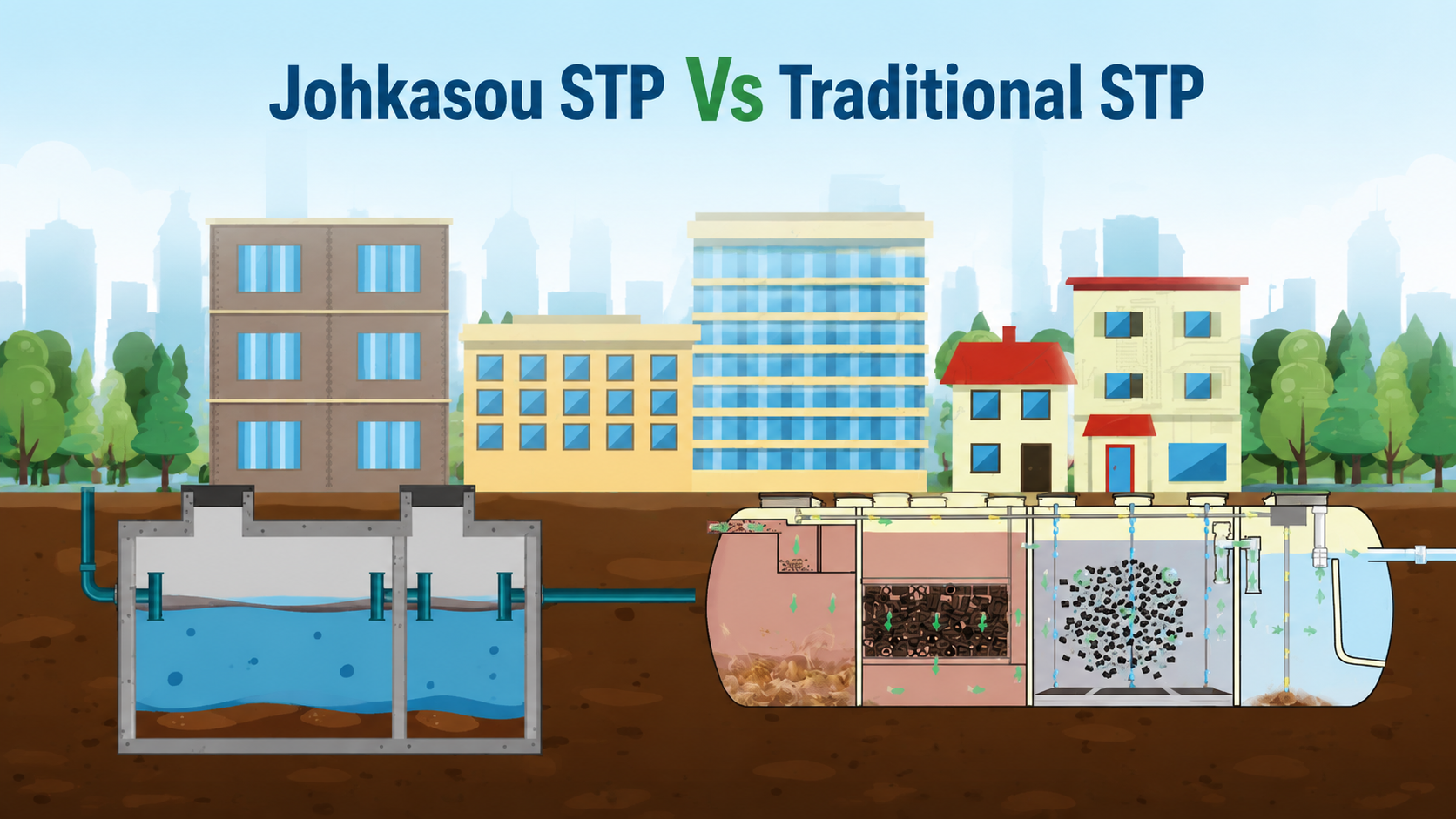
For building owners, developers, and businesses in Bangladesh, Johkasou vs Traditional STP has become an important comparison when choosing a wastewater treatment solution. Both systems treat sewage before it is safely discharged, but the way they are designed, installed, and operated is very different. Traditional RCC sewage treatment plants are built on-site with extensive civil construction, while Johkasou technology uses prefabricated FRP modules designed for compact installation, faster deployment, and decentralized wastewater treatment.
Choosing the right system depends on several factors, including available space, construction timeline, building type, wastewater volume, and whether the project is a new development or an existing building retrofit.
Johkasou Vs Traditional STP
The term STP (Sewage Treatment Plant) describes the purpose of a system — treating wastewater before discharge. It does not define the construction method or technology used.
In Bangladesh, building owners generally consider two approaches:
- Traditional RCC Sewage Treatment Plant
- Johkasou decentralized sewage treatment system
Both technologies can produce treated wastewater, but their installation methods, treatment process and suitability are very different.
How Traditional RCC Sewage Treatment Plants Are Built
A conventional RCC STP is constructed like a permanent civil structure.
The process usually involves:
- Site excavation
- Reinforced concrete tank construction
- Waterproofing and curing
- Installation of treatment equipment
- On-site testing and commissioning
The treatment process commonly uses technologies such as:
- Activated sludge process
- Extended aeration
- Biological treatment systems
Traditional RCC STPs have been widely used for decades and can work effectively, especially for large-scale developments where the treatment facility is planned from the beginning.
However, they also come with several challenges:
- Longer construction periods
- Higher dependence on site workmanship
- Significant excavation requirements
- Difficult modification after installation
- Greater disruption during retrofit projects
In Bangladesh, where many urban buildings have limited space and high groundwater levels, these factors can become major concerns.
How Johkasou Technology Works
Johkasou is a prefabricated FRP (Fibre Reinforced Plastic) sewage treatment system developed in Japan.
Unlike RCC systems that are built on-site, Johkasou units are:
- Manufactured in controlled factory environments
- Tested before delivery
- Transported as ready-to-install modules
- Installed with minimal civil work
Inside the compact unit, multiple treatment stages take place, including:
- Primary settling
- Biological treatment
- Filtration and clarification
- Disinfection
Johkasou technology was designed for decentralized wastewater treatment — meaning wastewater can be treated close to where it is generated without depending completely on a centralized sewer network.
This makes it highly suitable for locations where sewer coverage is limited, which is still a challenge in many parts of Bangladesh.
Johkasou vs STP: Key Differences Explained
1. Space Requirement
Traditional RCC STP
RCC plants require:
- Excavation space
- Construction access
- Formwork area
- Large structural footprint
The construction area can often become a challenge for existing buildings.
Johkasou STP
Johkasou systems are compact and flexible.
They can be installed in:
- Parking areas
- Basement spaces
- Building corners
- Limited open spaces
For urban buildings where land availability is limited, Johkasou provides a practical advantage.
2. Installation Time
Traditional RCC STP
Construction usually requires:
- Civil work
- Concrete curing time
- Equipment installation
- Testing
Depending on project size, installation can take several months.
Johkasou STP
Since the main treatment unit is factory-built, installation is much faster.
Typical installation includes:
- Foundation preparation
- Unit placement
- Pipe connection
- Electrical setup
- Testing
This significantly reduces project delays.
3. Civil Construction Requirement
RCC STP
Requires:
- Excavation
- Reinforced concrete work
- Waterproofing
- Structural engineering
Any mistakes during construction can affect long-term performance.
Johkasou
Requires:
- Foundation preparation
- Connection work
- Basic installation support
The reduced civil requirement makes it suitable for retrofit projects.
4. Retrofit Suitability for Existing Buildings
This is where the difference between Johkasou and traditional STP becomes most noticeable.
Many existing buildings in Dhaka, especially in areas like Gulshan, Banani, Baridhara, and other premium locations, were not designed with dedicated STP space.
Installing an RCC STP may require:
- Breaking existing structures
- Excavation around occupied buildings
- Parking disruption
- Major renovation work
Johkasou’s compact modular design makes it easier to integrate into existing buildings with minimal disturbance.
5. Quality Control and Reliability
RCC STP
The final quality depends heavily on:
- Contractor expertise
- Construction quality
- Waterproofing
- Material selection
Poor execution can reduce system lifespan.
Johkasou
Because units are manufactured and tested in factories, quality control is more consistent.
Each system follows a standardized manufacturing process before installation.
6. Expansion Capability
Building requirements can change over time.
Johkasou systems provide flexibility because additional modules can often be added according to future wastewater demand.
Expanding an RCC STP usually requires another major construction project.
Johkasou vs Traditional STP Comparison Table
| Factor | Johkasou STP | Traditional RCC STP |
|---|---|---|
| Construction Method | Factory-made FRP unit | Built on-site |
| Installation Time | Days to weeks | Months |
| Civil Work | Minimal | Extensive |
| Space Requirement | Compact | Larger footprint |
| Retrofit Suitability | Excellent | Challenging |
| Quality Control | Factory tested | Depends on site execution |
| Expansion | Modular | Difficult |
| Best Application | Buildings, apartments, retrofit projects | Large planned developments |
Where Traditional RCC STP Still Makes Sense
Johkasou is not a replacement for every type of wastewater treatment project.
Traditional RCC STPs can still be a good choice for:
- Large industrial facilities
- Municipal-scale treatment plants
- Large developments planned from the beginning
- Projects with sufficient land availability
For large centralized facilities where space and construction timelines are less restrictive, custom RCC solutions may remain economical.
The key is selecting the technology based on the project requirement.
Where Johkasou Works Best in Bangladesh
Johkasou technology is especially suitable for:
Apartment Buildings
Urban apartments often face:
- Limited installation space
- High wastewater generation
- Need for reliable treatment
Compact Johkasou systems provide an efficient solution.
Commercial Buildings
Suitable applications include:
- Offices
- Hotels
- Hospitals
- Shopping complexes
- Educational institutions
Existing Building Retrofit Projects
Johkasou is ideal where:
- The building is already occupied
- Space is limited
- Major construction is not practical
Areas Without Central Sewer Connection
Many areas in Bangladesh still lack complete sewer infrastructure.
Decentralized sewage treatment systems allow buildings to manage wastewater independently.
Why Johkasou Is Suitable for Bangladesh
Bangladesh’s urban wastewater challenges include:
- Rapid urbanization
- Limited sewer coverage
- Dense building development
- Restricted construction space
A decentralized sewage treatment plant approach helps buildings treat wastewater locally without waiting for large-scale sewer networks to expand.
For many urban projects, compact STP solutions provide a practical balance between compliance, installation speed, and long-term operation.
Proven Johkasou Applications in Bangladesh
Daiki Axis Bangladesh has implemented 100+ Johkasou-based wastewater treatment projects across Bangladesh.
Examples include:
- A 250 m³/day system at Tangail Medical College
- A 450 m³/day system at Aligonj Government Housing, Narayanganj
These projects demonstrate how modular FRP wastewater treatment technology can be scaled according to different site requirements.
Frequently Asked Questions About Johkasou vs STP
Is Johkasou better than traditional STP?
Johkasou is often more suitable for buildings with limited space, retrofit requirements, or locations without centralized sewer connections. Traditional RCC STPs may be better for large planned projects with sufficient land.
Is Johkasou available in Bangladesh?
Yes. Johkasou technology is available in Bangladesh through wastewater treatment providers offering design, installation, and maintenance services.
Is Johkasou suitable for apartment buildings?
Yes. Compact Johkasou systems are commonly used for apartments, housing complexes, offices, hotels, and commercial buildings.
Which STP requires less construction work?
Johkasou requires significantly less civil construction because the main treatment unit is manufactured and tested before installation.
Does Johkasou require maintenance?
Yes. Like all wastewater treatment systems, Johkasou requires regular inspection, cleaning, and operational maintenance to ensure consistent performance.
Which One Should You Choose: Johkasou or Traditional STP?
The right choice depends on:
- Building size
- Available installation space
- Wastewater volume
- Construction timeline
- Future expansion needs
- Compliance requirements
For many urban buildings in Bangladesh, especially retrofit projects, compact Johkasou systems offer significant advantages because they reduce construction challenges while providing reliable wastewater treatment.
Not sure which solution fits your building?
Daiki Axis Bangladesh can assess your site, evaluate your wastewater requirements, and recommend the most suitable STP solution.
Contact Daiki Axis Bangladesh for a technical consultation.
Disclaimer:
Technology selection should be based on site conditions, wastewater flow, and engineering assessment. Requirements and regulations may vary depending on location and project type.