
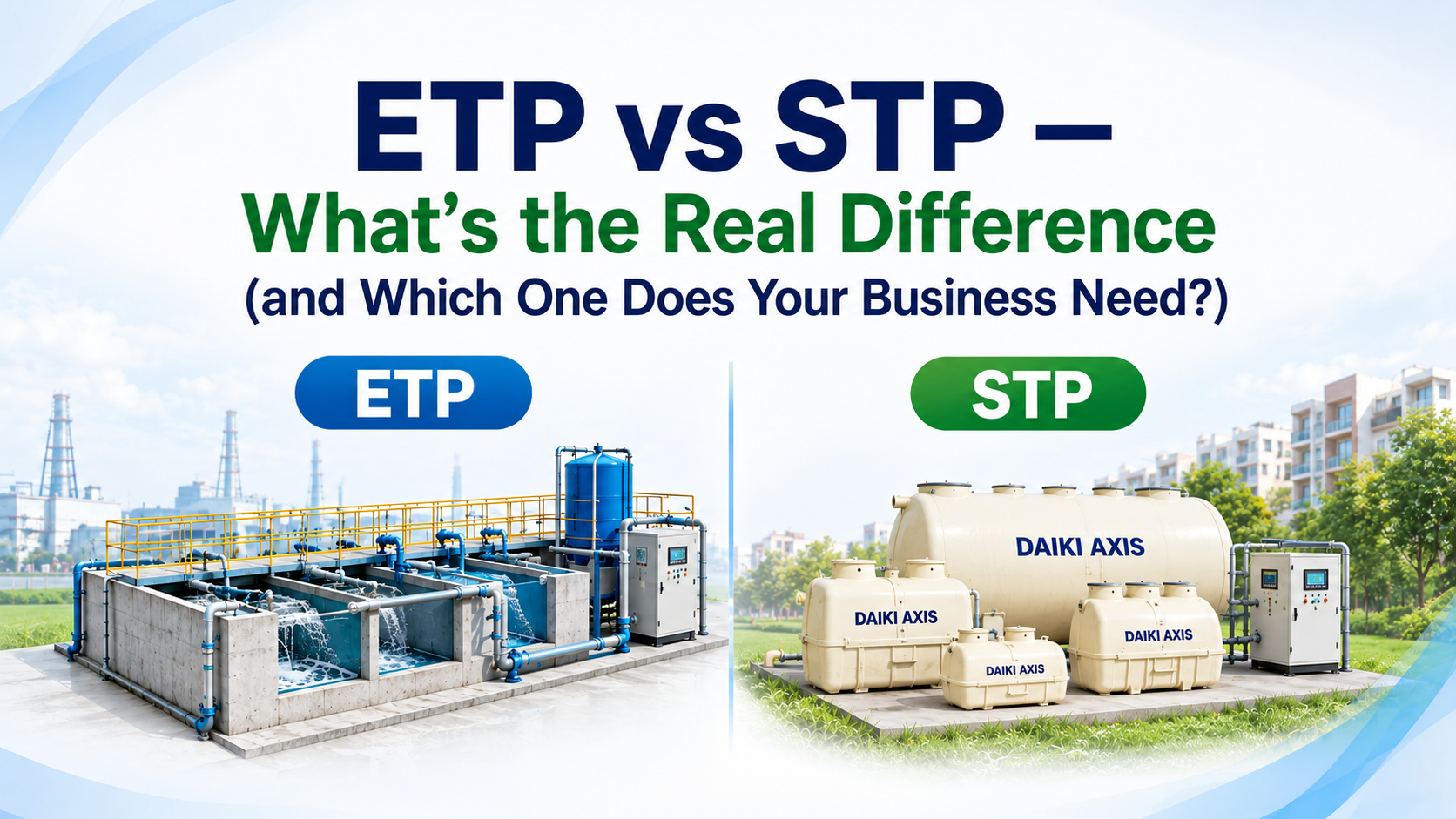
When discussing ETP vs STP in Bangladesh, the two terms are often used interchangeably, even though they treat very different types of wastewater. An ETP (Effluent Treatment Plant) is designed primarily for industrial wastewater generated from manufacturing and production processes, while an STP (Sewage Treatment Plant) treats domestic wastewater from toilets, kitchens, washrooms, and other sanitary sources.
Understanding the difference between ETP and STP is important because choosing the wrong wastewater treatment system can increase operating costs and may prevent a facility from meeting Department of Environment (DoE) discharge standards in Bangladesh. For businesses, factories, and commercial buildings, knowing whether an ETP or STP is required is therefore an essential first step toward effective wastewater treatment and environmental compliance.
What an STP (Sewage Treatment Plant) treats
An STP handles domestic and sanitary wastewater — toilets, kitchens, wash areas, laundries. This is “black water” and “grey water” generated by people living or working in a building: apartments, hotels, offices, hospitals, malls, schools. The pollution load is fairly predictable and mostly organic — biochemical oxygen demand (BOD), suspended solids, and pathogens from human waste. Because the load is consistent, STPs rely primarily on biological treatment: screening to remove solids, a biological stage (activated sludge, extended aeration, or a compact system like Johkasou) where bacteria break down organic matter, a clarifier to settle the treated sludge, and disinfection before discharge or reuse.
What an ETP (Effluent Treatment Plant) treats
An ETP handles industrial process wastewater — the water discharged specifically because of what a factory or industrial process does. Textile dyeing, garments washing, tanneries, pharmaceuticals, food processing, and chemical manufacturing all generate wastewater with a chemical fingerprint that’s specific to that industry: dyes, heavy metals (chromium, cadmium, lead), oils, solvents, high color, and unpredictable pH swings. Because the composition varies so much and can include substances biology alone can’t break down, ETPs typically need physicochemical treatment first — equalization to smooth out variability, pH neutralization, coagulation and flocculation to pull out chemicals and color — often followed by a biological stage similar to an STP’s, and sometimes tertiary polishing.
Why this distinction matters for compliance
Bangladesh’s Environment Conservation Rules (ECR) 2023 set specific, tighter discharge standards than the old 1997 rules. For textile effluent, for example, the maximum BOD limit dropped to 30 mg/L (from 100 mg/L), COD is capped at 200 mg/L, color is limited to 150 Hazen units, and there are specific limits on chromium, lead, cadmium, and other metals. An STP — even a well-built one — isn’t designed to remove heavy metals or industrial color, because it was never meant to. If your discharge actually comes from a production process, a domestic-style STP will not bring it within DoE limits, no matter how well it’s built or maintained. Conversely, if you’re only treating staff washroom water, a full industrial ETP is expensive overkill.
ETP vs STP: Which One Does Your Facility Need?
Ask: what’s actually going into the drain?
- Only toilets, kitchens, and washrooms in a residential, commercial, or institutional building → STP
- Wastewater from a production process — dyeing, washing, tanning, chemical processing, food manufacturing → ETP
- A factory or industrial park with both staff facilities and production discharge → both, usually kept as separate streams, since combining them makes each harder and more expensive to treat correctly
Many industrial sites in Bangladesh actually need both systems running side by side: an STP for the office block and staff washrooms, and an ETP for the factory floor. Treating them separately is almost always cheaper and more reliable than trying to combine two very different wastewater types into one system.
The compliance risk of getting it wrong
DoE inspections and mobile court enforcement have become more active in recent years, particularly around industrial clusters near the Buriganga, Turag, and other rivers. A facility with the wrong treatment system installed — or one labeled “ETP” that’s really only doing basic biological treatment — risks fines, closure orders, and reputational damage with buyers who audit supply chains for environmental compliance (a real issue for RMG exporters selling to international brands).
How Daiki Axis Bangladesh Approaches Sewage Treatment
Daiki Axis Bangladesh provides decentralized sewage treatment solutions designed to treat domestic wastewater directly at the source. Our packaged STP systems use Japanese Johkasou technology, offering a compact and efficient alternative to conventional centralized sewage treatment systems.
By treating wastewater close to where it is generated—such as residential buildings, commercial properties, hotels, hospitals, and institutions—Johkasou helps reduce infrastructure requirements while delivering reliable treatment performance. Daiki Axis supports projects from wastewater assessment and system sizing to installation, commissioning, and ongoing maintenance, providing a complete packaged sewage treatment plant (STP) solution in Bangladesh.
Quick FAQ
Can one plant do both ETP and STP duties?
Technically some hybrid designs exist, but combining domestic and industrial streams into one system almost always means over-engineering the biological stage to cope with the industrial load, or under-treating the industrial component. Two right-sized systems on separate streams are usually cheaper and more reliable than one combined system trying to do both jobs.
What happens if DoE finds the wrong system installed during an inspection?
Non-compliant discharge can result in fines, closure notices, or mandatory retrofitting under a deadline — which is a far more expensive and disruptive way to end up with the right system than planning for it up front.
Do hotels and hospitals need an ETP or an STP?
Almost always STP — their wastewater is domestic in nature (guest rooms, kitchens, laundry, washrooms), not industrial process discharge. A hospital with on-site labs handling hazardous chemical or biological waste is the exception, and needs separate specialized pretreatment for that specific stream before it can safely go into a standard STP.
Not sure whether your building or facility needs an STP? Talk to Daiki Axis Bangladesh’s engineering team for a free wastewater assessment — we’ll tell you plainly, based on what’s actually in your discharge, not on which system is easier to sell.