
If you’ve searched for “sewage treatment plant price in Bangladesh or “STP price in Bangladesh”, you’ve probably noticed something frustrating: nobody gives you a straight number. That’s not vendors being evasive — it’s because an STP isn’t a fixed-price product like a water pump or a generator. It’s an engineered system sized to your building, your wastewater, and your site. Two buildings with the same number of flats can need very different plants, and very different budgets.
What we can do is walk you through exactly what determines the stp price, so that when you do get a quote, you know whether it’s realistic.
1. Treatment capacity (m³/day)
This is the single biggest driver. Capacity is set by your daily wastewater flow — occupancy, unit count, or industrial process volume — not by the size of the plot. A small housing project might need a plant rated at 5-40 m³/day; a large residential complex can require 450 m³/day or more. Cost scales with capacity, but not in a straight line — very small plants carry a higher cost per cubic metre because base equipment (blowers, control panels, piping) doesn’t shrink proportionally, and very large plants benefit from economies of scale.
2. Technology and treatment process
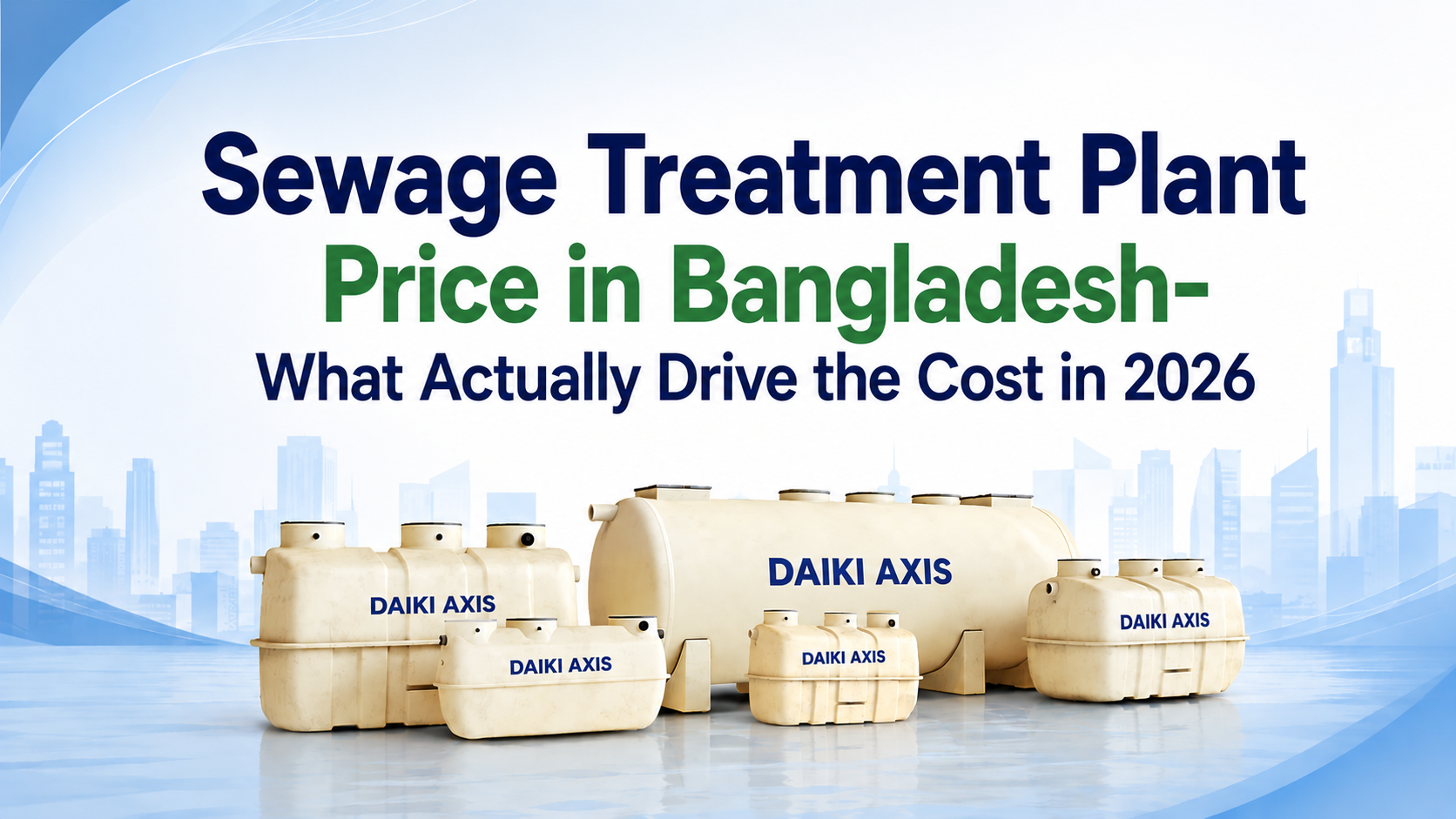
Conventional extended aeration or activated sludge plants built in reinforced concrete (RCC) and prefabricated fibre-reinforced plastic (FRP) systems like Johkasou solve the same problem with different cost structures. RCC tanks are built on-site over weeks or months of civil work. FRP modules are manufactured, tested, and delivered ready to install — the civil cost drops sharply, but the equipment itself carries a higher upfront unit cost. Over a project’s life, the two often land in a similar range, but the mix of civil vs. equipment cost is very different, which matters if your budget is split across contractors.
3. Wastewater characteristics
Domestic sewage from bathrooms and kitchens is relatively predictable and biologically treatable. Wastewater mixed with industrial or commercial process discharge — from a restaurant kitchen, a small workshop, or a dyeing unit — carries a heavier and more variable organic and chemical load. Under the Department of Environment’s Environment Conservation Rules (ECR) 2023, discharge limits are strict (for example, BOD is capped at 30 mg/L for textile effluent, down from 100 mg/L under the old 1997 rules). Meeting these limits on a more polluted stream requires more treatment stages, which adds cost.
4. Site conditions and civil work
Available space, soil type, groundwater level, and the shape of your plot all affect how much excavation and structural work is needed. A tight urban plot in Gulshan or Banani, where you’re often retrofitting a plant into an already-built structure, costs differently than a greenfield site where the STP is planned into the design from day one.
5. Material and build quality
FRP modules are lightweight, corrosion-resistant, and don’t degrade the way poorly cured concrete can in Bangladesh’s humidity and water table conditions. Cheaper imported plants sometimes cut costs on blower quality, pump durability, or control automation — and that shows up later as breakdowns, higher power draw, or plants that quietly stop meeting discharge standards within a few years.
6. Automation and monitoring
A plant with a proper control panel, alarms for blower or pump failure, and (increasingly) remote monitoring costs more upfront but avoids the far more expensive failure mode: an STP that silently stops treating wastewater properly while everyone assumes it’s working.
7. After-installation costs
The purchase price is not the total cost. Budget for:
- Annual Maintenance Contract (AMC) — servicing, part replacement, chemical dosing if applicable
- Electricity — blowers and pumps run continuously
- Sludge management — periodic removal and disposal
- Operator training or supervision
The real question isn’t “what’s the STP price in Bangladesh” — it’s “what’s the cost over 15 years”
A cheaper plant that needs major repairs in year three, fails a DoE inspection, or can’t be expanded when your building adds more units usually costs more than a properly sized plant did on day one. This is especially relevant right now, with RAJUK actively enforcing STP requirements in parts of Dhaka — a plant that gets flagged as non-compliant creates cost and delay far beyond the installation stp price.
How to get a quote you can actually compare
In conclusion, the STP cost in Bangladesh cannot be determined by a single fixed price, as capacity, technology, site conditions, and installation requirements all influence the final budget. Comparing the sewage treatment plant cost per capacity, package STP price, and overall STP installation cost in Bangladesh helps project owners choose a solution that delivers reliable treatment, regulatory compliance, and better long-term value rather than simply selecting the lowest upfront price.
Before you contact any supplier, have these ready:
- Occupancy or unit count (for residential) or process wastewater volume (for commercial/industrial)
- Plot size and available space for the plant
- Whether this is new construction or a retrofit into an existing building
- Where the treated water will go — municipal drain, canal, river, or reuse for gardening/flushing
With that information, Daiki Axis Bangladesh can give you a capacity-matched proposal — not a generic number — and walk you through exactly where every taka goes, from FRP module cost to the AMC that keeps it compliant for the long run.
Quick FAQ
Is there a “starting price” for a small STP in Bangladesh?
There isn’t a single honest number, even for small plants — a 10-flat building and a 30-flat building both sound “small,” but need meaningfully different capacity. What we can tell you on a first call, once we know rough occupancy and site type, is which price band you’re likely in before a formal site visit.
Why won’t suppliers just publish prices online?
Because a published price with no capacity attached is either misleadingly low (undersized, corners cut) or so padded with worst-case assumptions that it’s useless for comparison. A capacity-based quote, after knowing your actual numbers, protects you more than a headline figure would.
How long should a well-built STP last before major replacement?
FRP modules like Johkasou are built for decades of service life with proper maintenance; the electromechanical parts (blowers, pumps) typically need replacement on their own cycle — usually every several years — which is exactly why the AMC and total-cost-of-ownership numbers above matter more than the sticker price. Ready for an accurate quote instead of a guess? Contact Daiki Axis Bangladesh for a free site assessment and capacity-based proposal.